

Executive Governance Roadmap
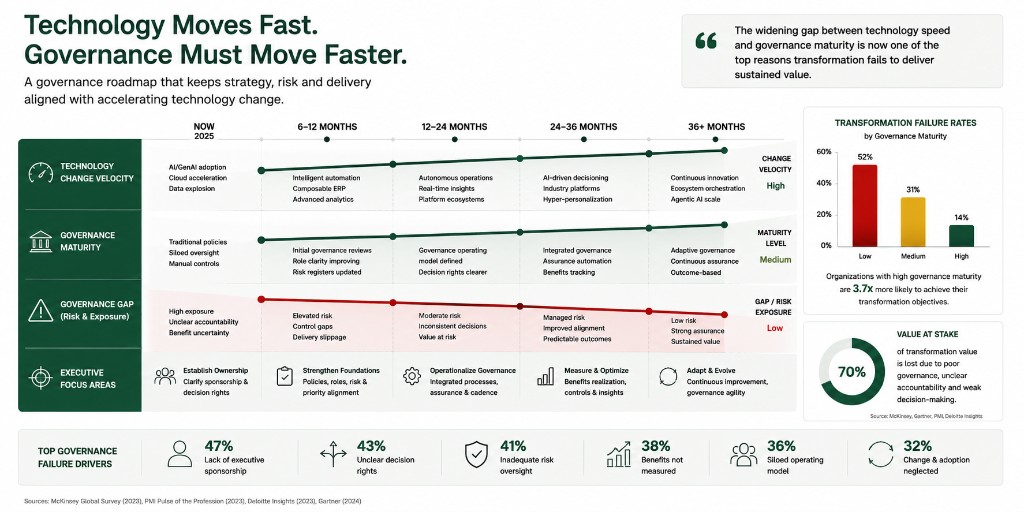
Figure 1. Executive Governance Roadmap
How executive governance maturity must evolve alongside accelerating technology change.
A governance operating model illustrating how executive decision rights, assurance, governance maturity and transformation risk evolve as technology adoption accelerates.
Source: Stratus Labs Executive Practice. Framework synthesized from executive transformation experience and publicly available research by McKinsey, Gartner, Deloitte, PMI and MIT Sloan Management Review.
Technology adoption now outpaces the policy, decision and assurance systems most organizations still rely on. When that gap widens, transformation risk rises even as delivery velocity looks healthy. Governance is not bureaucracy—it is the operating discipline that keeps ownership, decision rights, assurance and benefit realization moving in step with technology change. The roadmap shows that maturity must advance in stages: clarify sponsorship now, strengthen foundations, operationalize integrated processes, measure benefits, then adapt continuously. Executives should read the chart as a sequencing tool. The objective is not slower delivery. It is reducing execution risk while increasing the speed at which the enterprise can commit capital, scale change and remain accountable for outcomes.
Why Transformation Governance Fails
Most transformation programmes do not collapse because teams lack tools. They collapse because leadership cannot answer, with confidence, who may decide what under incomplete information. When that answer is missing, organizations invent informal authority—or they freeze. Both responses destroy value.
This is why transformation governance belongs on the CEO and board agenda alongside capital allocation. Technology choices create multi-year operating commitments: process paths, data definitions, vendor dependence and control design. Once those commitments harden, reversing them costs more than the original licence fee.
Strong executives therefore treat governance design as a prerequisite to major digital spend—not as a PMO template selected after the vendor is signed. The sequence is deliberate: clarify outcomes and rights, then release capital into delivery systems that can be steered.
Governance fails quietly before it fails publicly. Steering committees receive optimistic status. Dashboards stay green. Vendors report velocity. Meanwhile, process ownership is unresolved, control design lags configuration, and benefits remain unowned. By the time a board asks for evidence, capital and reputation are already committed.
The root pattern is consistent across enterprises and institutions: technology delivery creates facts on the ground faster than decision rights, policy and assurance can keep pace. Without a deliberate governance design, speed becomes a liability. With one, speed becomes a managed asset.
Without deliberate governance design, speed becomes a liability. With it, speed becomes a managed asset.
Corporate governance is therefore not a compliance overlay on transformation. It is the operating system that determines whether digital change, ERP modernization and operating-model redesign remain under executive control.
Executives often inherit governance artefacts that look complete: charters, RACI charts, stage gates and reporting calendars. Completeness is not the same as control. Control exists only when a named leader can intervene in time, with evidence, and with authority the organization recognizes under pressure.
A second failure mode is optimism bias institutionalized as process. When every gate can be waived by the same sponsor who owns delivery, governance becomes self-certification. Independent challenge—proportionate to consequence—is what converts process into assurance.
The cost of weak governance is rarely booked as a governance line item. It appears as rework, dual running, control failures, vendor change orders and leadership distraction. Measuring those proxies makes the case for redesigning decision rights before the next wave of technology spend.
When Technology Moves Faster Than Governance
Public institutions and regulated enterprises face a structural timing gap. Platform teams and suppliers can release capabilities in weeks. Policy, procurement, risk, labour relations and legislative processes often move in months or years. The executive problem is not pace alone. It is authority for decisions made before the institution has complete information.
When authority is unclear, organizations trend toward one of two failures. Some allow local experimentation to expand without sufficient oversight, creating unowned data, inconsistent controls and obligations that are difficult to explain later. Others require full certainty before any action, which shifts risk rather than reducing it. Services deteriorate, costs rise, and informal workarounds take hold.
Digital transformation governance must therefore distinguish among permission to test, permission to deploy and permission to scale. Each level needs a defined owner, an evidence threshold and a route for exceptions. A limited pilot may proceed with incomplete policy if exposure is contained and reversible. Enterprise adoption requires stronger evidence because financial, legal, workforce and public consequences are materially different.
Evidence should be decision-grade: specific enough to choose, contested enough to debate, and stable enough to audit later. Perfect certainty is rarely available. Governance that waits for perfection simply relocates risk into informal channels.
Exception routes matter as much as the standard path. Organizations without a legitimate exception process invent illegitimate ones. A written exception with owner, expiry and residual risk is healthier than silent non-compliance.
This distinction is as relevant to a retail ERP rollout as it is to a citizen-service platform. The technology differs. The accountability logic does not. Leaders who treat every release as either fully approved or fully blocked create either shadow IT or paralysis.
Permissions model for digital transformation governance
| Permission | Typical exposure | Evidence threshold | Owner |
|---|---|---|---|
| Test / pilot | Contained, reversible | Clear boundary, rollback path, named risk owner | Executive sponsor + control partner |
| Deploy | Operating impact in defined scope | Controls, data readiness, capacity, vendor dependence assessed | Accountable executive |
| Scale | Enterprise or institutional consequence | Benefit evidence, sustained ownership, residual risk accepted | Executive committee / board where reserved |
A useful executive question reframes the debate: what decision is due this month, who owns it, what evidence would change the decision, and what happens if we delay? Programmes that cannot answer that question are not under governance—they are under observation.
Programmes that cannot name the decision due are not under governance—they are under observation.
Technology vendors and internal product teams are incentivized to ship. Policy, risk and finance are incentivized to contain exposure. Transformation governance is the mechanism that forces those incentives into a single decision system. Without it, the organization runs two clocks and pretends they are synchronized.
Cloud platforms, low-code tools and AI capabilities compress the time between idea and operational footprint. That compression is useful only if leaders can still explain purpose, ownership, monitoring and withdrawal conditions. Otherwise the institution accumulates obligations faster than it accumulates capability.
In practical terms, every material digital release should carry a one-page accountability sheet: purpose, owner, data touched, control implications, monitoring plan and withdrawal trigger. If that sheet cannot be written, the release is not ready for enterprise exposure.
Five Executive Decisions That Cannot Be Delegated
Boards and CEOs can delegate analysis. They cannot delegate five decisions without surrendering control of the transformation agenda.
First, the outcomes that justify capital. Transformation without a short list of measurable outcomes becomes a catalogue of initiatives. Outcomes must be owned, baselineable and reviewable. Activity milestones are not substitutes.
Outcome discipline also prevents vanity metrics from capturing the agenda. Training completions, story points and module activations can be necessary leading indicators. They are not proof that customers, citizens, margins or control integrity improved.
Second, decision rights across the enterprise, functions and delivery units. Ambiguity here produces duplicated forums, delayed tradeoffs and local optimization that undermines the whole. Written rights—propose, challenge, decide, escalate—prevent governance theatre.
Third, the evidence standard for major gates. What is sufficient to pilot, to deploy and to scale? Without thresholds, every gate becomes a negotiation under political pressure.
Fourth, risk appetite and non-negotiable obligations. Control integrity, privacy, safety, citizen fairness and financial stewardship cannot be discovered at go-live. They must constrain design from the outset—consistent with the intent of widely used control frameworks that emphasize preventive and detective discipline rather than after-the-fact explanation.
Fifth, stop and reshape rules. The hardest executive decision is ending work that is funded, staffed and publicly announced. If stopping is culturally impossible, governance is decorative.
Five non-delegable executive decisions
| Decision | If left ambiguous | Executive test |
|---|---|---|
| Outcomes that justify capital | Initiative catalogue without owners | Can we name baselines and owners? |
| Decision rights | Duplicated forums and delayed tradeoffs | Who decides—and who escalates? |
| Evidence standards by gate | Political negotiation at every gate | What is enough to proceed? |
| Risk appetite & non-negotiables | Control and obligation surprises at go-live | What cannot be traded away? |
| Stop and reshape rules | Sunk-cost continuation | What evidence forces a stop? |
These five decisions form the spine of executive governance. Everything else—tooling, vendors, methodologies—is secondary. Business transformation succeeds when these choices are explicit and enforced through a management cadence.
If stopping is culturally impossible, governance is decorative.
Delegating these five decisions to a programme office without executive ownership is a common error. Programme offices can assemble evidence and options. They cannot set enterprise risk appetite or decide which operating commitments will end. When they are asked to, sponsors later disown the consequences.
Equally, boards that attempt to operate programmes create noise without improving accountability. The productive board posture is to test whether management’s decision system is real: reserved matters, evidence quality, cumulative risk and the integrity of stop rules.
Documenting the five decisions in a one-page executive charter does more for transformation outcomes than another layer of methodology training. Charters fail only when they are not used in live capital and scope decisions.
The Stratus Labs Transformation Governance Model
Stratus Labs approaches transformation governance as an implementable operating design—not a slide framework. The model connects mandate, decision rights, evidence, delivery assurance and value realization into one cadence executives can run.
At the top sits the mandate: the few outcomes that justify investment, the constraints that bind, and the institutional purpose the work must serve. Below that sits decision rights: who proposes, who challenges, who decides and who must escalate. Evidence standards define what is good enough at each gate. Delivery assurance tests readiness, dependency risk and control coverage. Value and stop rules close the loop so green status cannot substitute for realized outcomes.
In practice, the mandate statement should fit on a single page: outcomes, constraints, non-negotiables, capital envelope and the executive owner. If it cannot, the organization is not ready to govern delivery—it is still negotiating intent.
The governance pyramid clarifies altitude. Boards set risk appetite, capital envelopes and reserved matters. Executives own operating decisions and cross-enterprise tradeoffs. Programmes integrate design and delivery evidence. Operations produce the signals that make governance honest. Confusing these altitudes creates either micromanagement or abdication.
Decision-rights flow must be visible. A decision paper that states the change in facts, options, recommendation and dissent is more valuable than a fifty-page status pack. Cadence exists to clear decisions—not to rehearse progress narratives.
Lifecycle discipline matters as much as structure. Diagnose the governance gap. Design rights and thresholds. Install the cadence. Assure delivery with independent challenge where consequence is high. Realize value and adapt when evidence invalidates assumptions. Programme management disciplines emphasize integrated planning and benefit ownership for good reason: without them, transformation becomes ungoverned project activity.
Stratus Labs differentiates this model through operator accountability. Advice is shaped by executives who have held P&L, board reporting and multi-country operating responsibility—not by methodology alone. That is why our executive advisory and governance work ties counsel to decisions that must survive scrutiny.
Implementation detail matters. Cadence length should match decision latency, not vendor sprint rituals. Decision papers should be short enough to read and hard enough to fake. Escalation paths should be exercised, not laminated. Assurance should be risk-based: deeper where citizen impact, financial integrity or cyber exposure concentrates.
For multi-entity groups, the model must also govern exceptions. Unowned local variation recreates complexity in finance, ERP and data. Owned exceptions—with lifecycle cost and an expiry or review date—preserve necessary flexibility without dissolving the enterprise standard.
The model is intentionally compatible with established control and programme disciplines, while remaining implementable by executive teams who must act under incomplete information. The point is not framework purity. The point is accountable decisions that hold.
Board Questions Every Executive Team Should Ask
Boards do not need to operate programmes. They do need a short list of questions that expose whether management still holds the transformation under control.
What outcomes justify this capital, and who owns each outcome after the programme team leaves? If ownership dissolves at go-live, benefits will dissolve with it.
Which decisions are reserved to the board, which to the executive committee, and which to programme authority—and where have exceptions already become the norm?
What evidence would force a pause, reshape or stop—and has that evidence standard been tested on a live decision, or only agreed in principle?
Where is cumulative risk concentrating across the portfolio: data, cyber, vendor dependence, workforce capacity, citizen or customer impact?
How does management distinguish delivery status from value evidence? Green milestones with weak benefit proof are a classic board blind spot.
For digital and ERP agendas specifically: who owns process design, who owns controls, and who owns data quality at source—not in a temporary project role?
Public Sector & Pakistan Perspective
These questions keep board governance focused on accountability and exposure. They also signal to management that theatrical transformation will not pass.
Boards should also ask whether management capacity matches the volume of concurrent change. Overloading operators is a governance failure disguised as ambition. A portfolio that cannot be absorbed will invent shadow work and silent non-compliance.
Where AI or advanced analytics enter the agenda, boards need the same clarity applied to model purpose, monitoring for deterioration, human escalation and decisions that must not be delegated. Novelty does not reduce the need for ownership.
Board packs improve when they replace narrative volume with a decision log: decision required, owner, latest responsible date, evidence available, options, recommendation and consequence of delay. That format exposes decision latency before it becomes delivery failure.
Public-sector modernization is judged twice: once by whether a system or service launches, and again by whether the institution can explain the decision trail, the use of funds and the effect on citizens or regulated parties. Programmes that optimize only for launch dates often fail the second test.
Procurement success is frequently mistaken for modernization success. An awarded contract does not establish process ownership, adoption readiness or cross-agency decision rights. Executive reporting should therefore track unresolved design decisions, dependency risk, control coverage and benefit evidence alongside commercial status.
Evidence standards give public leaders a practical way to move without pretending certainty. A pilot may proceed with contained exposure and clear reversibility. Deployment requires stronger assurance on controls, data, operating capacity and vendor dependence. Scale should demand proof that benefits are real, obligations are owned and residual risk is acceptable to the governing body.
In Pakistan’s institutional and enterprise environment, the same logic applies with sharper constraints. Capital availability, specialist capacity, procurement rules, multi-entity group structures and the need for decisions to remain explainable under scrutiny all shape what can be sequenced responsibly. Ambition without governance becomes a catalogue of intentions.
Family enterprises professionalizing governance, regulated operators and public institutions share a common requirement: consequential choices must have owners, evidence and escalation paths. Cross-border groups need explicit enterprise standards and owned local exceptions—otherwise finance, ERP and controls recreate fragmentation at scale.
In Pakistan, consequential choices must remain explainable under scrutiny—not only deliverable on a plan.
ERP Governance as Enterprise Operating Change
International public-accountability themes—transparent decision trails, proportionate controls and citizen-outcome orientation—reinforce this discipline without importing theatrical programme language. Leaders seeking structured counsel on transformation governance can request an executive briefing.
Pakistan’s operating reality also includes the professionalization of governance in family enterprises, the modernization of public services under procurement and political scrutiny, and the coordination challenges of groups spanning domestic and international markets. In each case, transformation governance is the difference between staged investment and uncontrolled initiative sprawl.
Practical sequencing often means fewer concurrent programmes, clearer enterprise standards for finance and master data, and earlier involvement of control functions—so redesign is not postponed until an auditor forces it. That discipline is how institutions modernize without theatrical programmes that cannot withstand review.
Where public funds or regulated obligations are involved, decision trails must be designed for later explanation. That requirement should shorten, not lengthen, the list of priorities: only what can be owned, evidenced and sustained should enter the funded agenda.
ERP programmes concentrate governance risk because they rewrite how money, inventory, people and obligations move through the enterprise. Treating ERP as a software replacement is the most expensive category error executives still make.
ERP governance begins before vendor selection. Leaders must decide whether the mandate is infrastructure risk reduction or operating-model redesign. Confusing those ambitions expands scope without an honest adjustment to time, cost and risk. ERP consulting and modernization should therefore start with process ownership, control requirements and data accountability—not with feature theatre.
ERP governance checkpoints
| Phase | Governance focus | Failure signal |
|---|---|---|
| Before selection | Mandate clarity: migrate vs redesign | Feature theatre without process owners |
| Design & build | Exceptions, controls, data accountability | Customization growth without cases |
| Cutover | Readiness, control continuity, operating capacity | Go-live on technical criteria alone |
| Stabilize & realize | Operating metrics and benefit ownership | Parallel spreadsheets persist |
During implementation, executive forums must decide exceptions, not merely receive status. Every material process variation needs a case: value, lifecycle cost, control impact and owner. Data migration is an accountability test. Cutover readiness includes control continuity, not only technical go-live criteria.
After go-live, governance must shift from project reporting to operating performance: close quality, exception volumes, master-data integrity, benefit realization and the retirement of parallel spreadsheets. If those measures are absent, the organization has bought a platform and kept its complexity.
ERP governance begins before vendor selection—and continues after go-live as operating performance.
Common Governance Anti-Patterns
Digital transformation governance and ERP governance are the same discipline applied to different estates. Both require staged permissions, decision-grade evidence and the courage to stop work that no longer earns its capital.
ERP governance also intersects cyber and third-party risk. Concentration in a single integrator, opaque custom code and weak identity controls are board-level exposures. Executives should require a clear map of who can change what, how segregation of duties is enforced, and how emergency access is monitored after go-live.
Finance transformation and ERP must be governed as one agenda when close, controls and reporting depend on the platform. Separating them into parallel workstreams without shared decision rights is how organizations buy a system and keep their reconciliation factory.
A practical ERP governance pack for executives includes: process owners by domain, exception register with lifecycle cost, control design status, data quality ownership, cutover readiness criteria, and a benefit baseline that finance will validate.
Certain anti-patterns appear so reliably that executives should treat them as early warning signals.
Status without decisions: long packs, short choices. If a forum cannot name the decision due, it is a briefing, not governance.
Permission collapse: treating pilot, deploy and scale as one approval. This either blocks learning or industrializes immature designs.
Vendor-led scope: allowing implementation partners to define process truth while internal owners remain nominal. Accountability cannot be outsourced.
Control lag: configuring systems first and designing controls later. Remediation then becomes a second programme under audit pressure.
Benefit fiction: claiming value from activity metrics—trainings completed, tickets closed, modules live—without baseline-owned outcomes.
Exception culture: so many local variations that the target operating model exists only in presentations.
Executive Governance Checklist
Portfolio blindness: reviewing projects in isolation while duplicated platforms, competing data definitions and cumulative cyber exposure grow unchecked.
Anti-patterns persist because they are socially convenient. Status packs feel like progress. Waivers feel like pragmatism. Vendor confidence feels like expertise. Governance exists to make the inconvenient questions routine: what is the decision, what is the evidence, who is accountable, and what will we stop?
Executives should audit their last three steering cycles against these patterns. If two or more appear, the issue is not delivery talent. It is the decision system.
Conclusion: Speed Without Loss of Control
Executives can use a short checklist to test whether transformation governance is real. The items below are designed for CEOs, CIOs, CFOs and programme sponsors who must defend decisions to boards, auditors and—where relevant—public oversight.
Technology will continue to move faster than policy. That is not a temporary inconvenience. It is the operating condition of modern institutions. The organizations that endure are those that design decision rights, evidence thresholds and stop rules with the same seriousness they bring to platform selection.
Transformation governance, board governance, digital transformation governance and ERP governance are not separate specialisms for separate committees. They are one accountability system applied at different altitudes. When that system works, delivery can be fast without becoming reckless. When it does not, speed only accelerates the loss of control.
Stratus Labs advises leaders who need counsel that holds under scrutiny—practical, operator-informed and tied to measurable outcomes. Explore our governance and performance capability, learn more about our executive practice, or request an executive briefing on the mandate ahead.
Leaders who install this discipline early spend less later on remediation, audit firefighting and reputational repair. They also create room for genuine innovation—because the organization can distinguish reversible tests from irreversible commitments.
If your transformation agenda is moving faster than your ability to explain decisions, the next useful step is not another tool. It is a governed conversation about rights, evidence and outcomes. That is the conversation Stratus Labs is built to support.
Executive insights
Executive Insight
Separate permission to test, deploy and scale—or speed will outrun accountability.
Board Perspective
Demand the distinction between delivery green and value evidence on every material programme.
Practical Recommendation
Publish decision rights and evidence thresholds before the next capital release.
Risk
ERP and digital estates amplify unowned exceptions until controls and data ownership are explicit.
Leadership Consideration
Stop rules must be culturally real; otherwise governance is theatre.
Opportunity
Institutions that govern paced change convert technology speed into durable performance.
Published August 1, 2026 · Updated August 1, 2026 · 24 min read
Related industries: Government · Enterprise · Energy · Financial Services · Education
Related capabilities
Governance & Performance
Transformation governance and enterprise performance consulting for leaders seeking faster decisions, clear accountability, and reliable evidence of results across strategy, investment, operations, risk, and institutional commitments, with proportionate control, disciplined escalation, authoritative measures, documented ownership, and stronger executive management decision follow-through.
Strategy & Transformation
Enterprise strategy and transformation consulting for leaders redesigning operating models, allocating capital, and improving organizational performance through explicit choices, accountable execution, and evidence-led value realization.
Program & PMO
Program management and PMO consulting for complex portfolios requiring delivery assurance, integrated planning, and executive control across internal teams, suppliers, financial commitments, operational readiness, and realized value, with earlier warning, credible forecasts, and timely intervention where outcomes are exposed.
ERP & Core Systems
ERP modernization consulting for finance, supply chain, workforce, and core operations from business case through implementation and stabilization, with retained business authority, controlled standardization, and measurable post-go-live operational performance.
Continue the Conversation
If your organization is navigating governance, ERP modernization or business transformation, our advisory team can help.